|
| | SoGetMatrixAction (const SbViewportRegion &newRegion) |
| | Constructor takes viewport region to use for picking.
|
| |
| virtual | ~SoGetMatrixAction () |
| | Destructor.
|
| |
| void | setViewportRegion (const SbViewportRegion &newRegion) |
| | Sets/returns current viewport region to use for action.
|
| |
| const SbViewportRegion & | getViewportRegion () const |
| | Sets/returns current viewport region to use for action.
|
| |
| SbMatrix & | getMatrix () |
| | Returns cumulative transformation matrix.
|
| |
| SbMatrix & | getInverse () |
| | Returns cumulative inverse transformation matrix.
|
| |
| SbMatrix & | getTextureMatrix () |
| | Returns cumulative transformation matrix.
|
| |
| SbMatrix & | getTextureInverse () |
| | Returns cumulative inverse transformation matrix.
|
| |
| virtual | ~SoAction () |
| | Destructor.
|
| |
| virtual SoType | getTypeId () const =0 |
| | Returns the type identifier for a specific instance.
|
| |
| bool | isOfType (SoType type) const |
| | Returns TRUE if this instance is of the type specified in type or is derived from that type.
|
| |
| virtual void | apply (SoNode *node) |
| |
| virtual void | apply (SoPath *path) |
| |
| virtual void | apply (const SoPathList &pathList, bool obeysRules=FALSE) |
| | Initiates an action on the graph defined either by a node, path, or list of paths.
|
| |
| virtual void | invalidateState () |
| | Invalidates the current traversal state in the action, forcing it to be recreated when the action is next applied.
|
| |
| AppliedCode | getWhatAppliedTo () const |
| | Returns code indicating what action is being applied to.
|
| |
| SoNode * | getNodeAppliedTo () const |
| | These returns a pointer to the node, path, or path list the action is being applied to.
|
| |
| SoPath * | getPathAppliedTo () const |
| |
| const SoPathList * | getPathListAppliedTo () const |
| | A single path list may be split into several, one for each different head node.
|
| |
| const SoPathList * | getOriginalPathListAppliedTo () const |
| |
| bool | isLastPathListAppliedTo () const |
| |
| PathCode | getPathCode (int &numIndices, const int *&indices) |
| | Returns path code based on where current node (the node at the end of the current path) lies with respect to the path(s) the action is being applied to.
|
| |
| void | traverse (SoNode *node) |
| | Does traversal of a graph rooted by a node.
|
| |
| bool | hasTerminated () const |
| | Returns TRUE if the traversal has reached a termination condition.
|
| |
| const SoPath * | getCurPath () |
| | Returns a pointer to the path accumulated during traversal, i.e., the chain of nodes from the root of the traversed graph to the current node being traversed.
|
| |
| SoState * | getState () const |
| | Get the state from the action.
|
| |
| PathCode | getCurPathCode () const |
| | These methods maintain the current path accumulated so far during traversal.
|
| |
| void | pushCurPath (int childIndex) |
| |
| void | popCurPath (PathCode prevPathCode) |
| |
| virtual SoNode * | getCurPathTail () |
| | This is virtual, so that SoCallbackAction can use current node.
|
| |
| void | usePathCode (int &numIndices, const int *&indices) |
| | called by inline getPathCode:
|
| |
| void | pushCurPath () |
| | Optimized versions of push/pop when we know path codes won't change:
|
| |
| void | popPushCurPath (int childIndex) |
| |
| void | popCurPath () |
| |
| const SoLightweightPath & | getCurrentLightweightPath () const |
| | Returns the current "light" path.
|
| |
| void | setCurrentLightweightPath (const SoLightweightPath &path) |
| | Sets the current "light" path.
|
| |
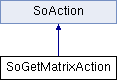
This action computes transformation matrices for a given subgraph. It computes the cumulative transformation matrix and its inverse, along with a cumulative texture transformation matrix and its inverse.
This action is unlike most others in that it does not traverse downwards from groups. When applied to a node, it computes the matrix for just that node. (This makes sense for transformation nodes, but not for others, really.) It is much more useful when applied to a path. When applied to a path, it gathers the transformation info for all nodes in the path and those that affect nodes in the path, but it stops when it hits the last node in the path; it does not traverse downwards from it as other actions (such as rendering) do. This behavior makes the most sense for this action.
- See Also
- SoGetBoundingBoxAction
Definition at line 90 of file SoGetMatrixAction.h.
 Public Member Functions inherited from SoAction